



The rise of AI
For the longest time, high schools ran on lined paper. They ran on scholastic notebooks, Ticonderoga pencils, and—most crucially—the honest curiosity and integrity of students. When quarantine came around in 2020, the United States moved onto digitalization more rapidly than ever. High schools ever since have incorporated and, in some cases, fully rely on digital applications and devices to teach their students, like Google Classroom, Zoom, and other online programs.
Then came Artificial Intelligence. Beginning in 2022, the tool was so powerful that it took the digital world by storm; the forerunner of this moment being ChatGPT, with Gemini, SoraAI, and other applications to follow. ChatGPT’s release in the unsuspecting year of 2022 made complex technology become accessible to the general public for the first time, and with this door opened, many more companies pushed their own programs through it. Schools across the country have adopted AI into their curriculum, encouraging students to utilize the tool for research or brainstorming purposes. Students, over the course of AI’s rise to omnipresence, are learning to take advantage of the swift-thinking power that it possesses for their educational benefit.
In 2026, AI is ubiquitous. As I am researching this topic, I am met with AI Overview answers every time I use the Google engine. Get onto Pinterest and you’ll likely see AI generated pins, too. Or, on Musk’s X—more often than not, there are AI-operated bot accounts everywhere and equally as many comments mentioning @grok under every post.
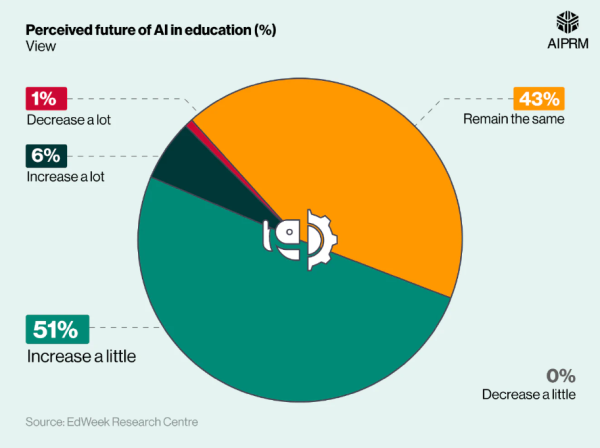
Now that AI has spread into almost every facet of our digital lives, the question now becomes whether or not AI has a place in education. While there are definitive benefits to the tool—for instance, its time-saving abilities and its brainstorming capabilities—others beg to differ that these benefits are not worth the cost of environmental damage that is needed to power AI servers, as well as the belief that AI can cause students to be too reliant on it and less hardworking.
Here at James Caldwell High School, I asked a few of my teachers their opinions on the matter. I understand the nuances behind AI; while there are many positives, there are also no limits to its use, which can possess a detrimental effect. I was curious to learn more about the perspective of our schools’ educators, who are also likely forced to close proximity with AI within their career.
What do our teachers think?
I first asked Mr. Phelan his point of view on the matter. As an AP Literature teacher, as well as the mastermind behind The Caldron itself, it was hard to predict what his views could be. AI is one of the most helpful tools for writing and brainstorming, but I still wondered if he saw AI for its flaws.
“AI doesn’t help your ability to think or write,” Mr. Phelan admitted to me, “but it’s a powerful research tool, [and] I do use it a lot for, just like, personal questions,” He gave me a common example: imagine one has a plumbing problem in one’s home. Mr. Phelan explained to me that in a scenario like this, he would simply ask an AI bot for assistance on the matter. I completely agree with this approach—AI is undeniably extremely useful for solving complex problems that would otherwise require the costly advice of a professional or the tedious internet-scavenging for a homemade tutorial. In the same way, that utility can be applied to education. Mr. Phelan further agrees that AI is beneficial for “giving ideas”, which speeds up the brainstorming process of research projects. In education and in personal life, he believes, AI has a lot to offer.
The cons of AI are not lost on Mr. Phelan, however. He expresses a latent discomfort and anxiety about the future of AI: “It’s kind of sad and scary because it does seem like the creators of [AI] just envision replacing human labor,” In his words, he gave me a perspective that I actually forgot to consider—AI is the catalyst behind the gradual removal of human jobs. The concept is a bit frightening. To imagine a future where secretaries, servers, and even educators themselves can be replaced by AI somehow doesn’t feel too far off. Mr. Phelan finds himself asking, “What happens after that?”
After a lesson one day, I approached Mr. Olsen about his feelings on AI. The rising of AI is, in a way, similar to the rising of calculators: complex, lengthy problems, and the written techniques to solve them were supplanted by mastering commands of calculators, all made easy like any problem asked of AI. As he is a math teacher, I was truly curious about his perspective on its benefits in education.
“I don’t have a lot of experience with AI,” Mr. Olsen began. The few times he has used it, it was for help with creating lesson plans, but he “found it doesn’t get across the point [he] wanted to get across.” In regards to student use of AI, Mr. Olsen explained to me that “It’s not a true testament to what students’ thoughts are,”—a statement I wholly agree with. In other words, Mr. Olsen believes that AI cannot replace student thinking and authenticity. He believes AI is pretty useful for brainstorming and helping students with research papers, but he doesn’t think applications like ChatGPT are anything too different from searching answers up on Google and getting an AI overview—there’s really no need to go onto applications like Chat with Google already imposing AI into its system.
Perhaps Mr. Olsen’s biggest concern with AI is the cost of resources. It’s a widely shared criticism that AI data centers can use millions of gallons of water daily. Mr. Olsen gave me a very thought-provoking comparison: “It’s taking, you know, a sledgehammer to push in the thumbtack.” While AI does give students the help that they need, he questions if a prompt is worth “the cost of a lot of resources,” (the sledgehammer) instead of a Google search or help from a person in real life (less detrimental alternatives). Though he acknowledges its benefits in brainstorming, Mr. Olsen deems himself not a fan of AI and its environmental damage. “It can certainly be helpful for a push in the right direction if you’re stuck, but… is it overkill?”
When it comes to history and social studies, AI could be an especially useful tool for studying, researching, and brainstorming alike. Curious about a history teacher’s opinion on the matter, I contacted Ms. Dmytriv, who teaches U.S. History and APUSH. “As an AP U.S. History teacher, I view AI as a valuable support tool when used thoughtfully,” she replied, “but not as a replacement for student thinking,” It seemed to me that both Mr. Olsen and Ms. Dmytriv agreed about AI’s constraints—while the tool is definitely helpful, it should not completely take the place of student thinking. She continued, “I encourage using AI for brainstorming, clarifying concepts, or getting unstuck, but not for producing final answers,” The tool is best as a support for the background processes, the work-in-progress portion of assignments, but not as an end-all cheat code to the assignment entirely. Ms. Dmytriv concluded decisively: “Ultimately, [AI] should serve as a source of inspiration that enhances learning, not something that does the intellectual work for you,” and I personally could not have agreed more.
After speaking with some of JCHS’ most pivotal and experienced educators, my opinion on AI has expanded. There appears to be a universal acknowledgement of AI’s benefits in regards to student learning and preparation for assignments, research papers, and projects. There are even personal uses provided by the highly intelligent tool. The constraints of AI, however, remain at high concern for some teachers. The obsolescence of student authenticity and the environmental damage contributed by AI are not lost on educators here in JCHS. Moving forward, as AI inevitably becomes a more present tool in our world, it will be interesting to see how our teachers’ opinions solidify or waver.