








On an international scale, participation in sports serves as an essential component of adolescent life, with organizations like the National Center for Health Statistics reporting that 54.1% of children from ages 6-17 worldwide and 49.1% of high school students in the US alone are members of at least one team. Involvement in such activities plays a crucial role in the development of young minds—fostering self-confidence, the capacity for teamwork, and strong discipline and work ethic, among countless other key life skills—thus enabling teens to access their fullest potential on the playing field and beyond.
While high schoolers have traditionally engaged in sports by joining the teams at their high schools, the past few decades have witnessed a massive increase in the popularity of club sports, where athletes join teams separate from the academic institutions they attend. As club team membership continues to climb dramatically, one can’t resist the urge to ask: what exactly makes club sports so appealing—and, as numerous coaches throughout New Jersey fear, could they pose a threat to high school athletic programs?
Running in another lane: Nick Magnone
There are a variety of reasons which may lead a high school athlete to join a club team, either by choice or force: the athletic program offered by the athlete’s high school may be underdeveloped and not meet their needs to become their best; the training philosophy of the athlete’s coach may not be the right fit for the athlete’s goals; or a high school may not even offer the athletic program in which the student wishes to participate.
Current student-track-&-field-athlete at Christian Brothers Academy Nick Magnone faced an unexpected challenge: CBA has a nationally revered cross country/long-distance program and a formidable sprinter program…but no coaching for the mid-distance events (400m, 800m), where Nick’s talents lie.

“Realistically,” Nick expressed, “trying to aim for a 1600 SAT and 4.0 UW [unweighted] gpa is out of the cards for me. I knew track could open a path for education for me.”
This placed Nick in a precarious position, calling him to search for other coaching in the area and even consider switching schools.
“In a way, it was a necessity.”
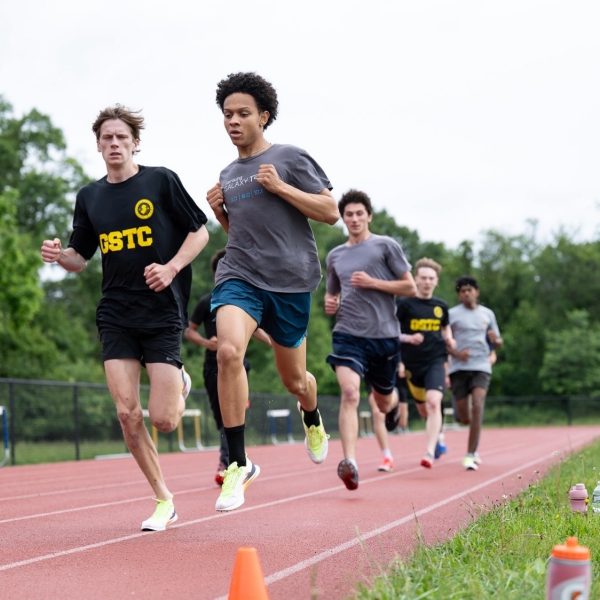
When Nick joined the Garden State Track Club (GSTC) last Fall, he originally planned on “doing GSTC year round with the sole exception of [the] spring season”. However, plans had changed following his spectacular first indoor season with the club, going as far as qualifying to compete in the 800m at Adidas Indoor Track Nationals. From then-on, his involvement in the GSTC became “an ongoing linear progression” with him committing to it year-round.
“Not only was the intense workout sessions paying off, but the easy days that Chuck (track coach) assigns allows me to be consistent and minimize injury.” Chuck Schneekloth, the founder and primary coach of the GSTC, updates his athletes’ personalized training plans at the beginning of every week through to the next Monday. “This allows me to plan my week ahead of time while also being consistent with GSTC.”
The typical week of training for a mid-distance to long-distance runner consists of two “workout” days (usually one on either Tuesday or Wednesday paired with one on Saturday, where club members meet at several different enclaves to train with their teammates) and mileage runs at “easy pace” for the other four to five days of the week, where athletes simply have to cover the distances prescribed by Coach Chuck on each given day at a non-strenuous level of effort (the seventh day, either Sunday or Monday, is usually off).
By religiously adhering to his personalized GSTC training program, Nick dropped a staggering six seconds in the 800m to conclude his Junior year with a personal record of 1:56.11—a time that has opened conversations between Nick and the impressed coaches from several US top 20 schools.
Having climbed to the remarkable heights that he long knew he was capable of attaining, Nick remarks, “[the] GSTC allowed me to believe that I can go for the reach schools that everyone dreams of”.
As he now prepares to return to the 800m with blazing ambition this winter season, Nick serves as a testament to the life-changing opportunities that club athletics have offered to potent high schoolers caught in unideal circumstances—and his success story is only one of the many attached to the GSTC alone.
However, club sports still haven’t been unanimously welcomed, and one could argue (as many throughout the state have) for good reason.
A double-edged sword
There have been controversies in a number NJ school districts regarding high school students choosing to participate in club teams instead of their high school teams, with high school coaches arguing that clubs are “stealing their best players” and that club involvement is a “problem”.
This conflict stems from the core difference between club athletics and high school athletics: high school athletics offer a more team-oriented experience while club athletics tend to be majorly—if not solely—focused on the athlete as an individual.
Recognizing this, James Caldwell High School Athletic Director Dan Romano expressed his firm belief that “the team concept is so much more important than the individual gain”.
“I played [football for JCHS] in 1975, we just had…a 50 year reunion and twelve of those guys showed up at the reunion. So those are people that I’ve been in contact with all these years…and I think that’s really important.”

Although a club like the GSTC undeniably has a strong, tight-knit team environment, as mentioned earlier, the members of the club are only training with their teammates during two days of the week, at most. Additionally, members of the GSTC come from all corners of the state and beyond, so those practices (and competitions every few weeks) often account for the only time that teammates spend with each other. As a result, while involvement in such a club does allow the creation of meaningful friendships, one could argue that it does not offer the same overall team experience—training with your team daily, riding the bus to meets together, and so on—as high school athletics.
So, generally believing that “high school athletics is better for the individual”, Mr. Romano stated that “pull[ing] the best player off of a soccer team to a club sport” is just as harmful to the stand-alone athlete as the high school team that they leave without a key player.
Moreover, Nick “can see where the HS [high school] coaches are coming from”, as “not only are their best runners [and other kinds of athletes] being taken, but they also have a job at the end of the day. If they don’t meet the school requirements they get fired for something that is not their fault”.
However, “for an individual sport like track”, Mr. Romano concedes, “I think I’m ok with [participation in club sports]…we have great coaches, I’m not besmirching any of our coaches, but…training for those types of situations is probably better”.
And, as shown in Nick’s case, it certainly can be. Clubs like the GSTC propel their athletes towards excellence by taking immense care to ensure that each athlete is following a personalized program that is best fit for them, individually. Providing his athletes with running, lifting and plyometric training plans constructed case-by-case by a certified level 1 coach, Mr. Schneekloth more than delivers for the self-growth-focused athletes seeking to harness their full potential.
The emphasis on the individual athlete also eliminates the potential for a major problem far too common to sports like track: being (either intentionally or unintentionally) overworked at the hands of a coach. “Personally”, Nick shared, “HS coaches have made me ran 3 or more events in [one meet]…sometimes they believe that more is better, which is not always the case.” By giving his athletes easy runs most days of the week and prioritizing quality over quantity when planning racing schedules with them, Coach Chuck takes action to protect the members of the GSTC from burnout and overuse injuries.
In fact, there are circumstances in which JCHS’ athletic director has supported the participation of Caldwell athletes in “individual” (i.e. individual-focused) club sports—but with a catch.
“A lot of our kids swim with club [in the off-season]. But I do think it’s important that [in season]…they are allowed to compete with their [high school] teams…I think that’s the major problem with club athletics, it’s during the season in high school, so it keeps that athlete from being with his team.”
“So”, Mr. Romano concludes, “I do think that there’s a lot of benefits in those [individual] sports, but for the team concept, the team sports, I certainly like to see…kids stay with high school.”
Concluding Thoughts
As a member of the GSTC myself and one of Nick’s teammates, I can passionately attest to the life-changing experience of being the member of this club team for many of the same reasons as Nick. However, as both Nick and Mr. Romano recognize, club sport is by no means “superior” to high school athletics, and it certainly has some drawbacks worthy of consideration.
Ultimately, I believe that club sports serve as a crucial option for high school athletes—from those who seek the best from themselves beyond what their high school team may be able to offer to someone who simply seeks the opportunity to participate in a sport which may not be offered at their high school—and should be available to them if they so choose to pursue it. Regardless of how dramatically club membership continues to escalate, the high school team will always exist as an outstanding choice for the student-athlete looking for a convenient, tight-knit collective experience that isn’t necessarily characterized by the high demands of club training.
Athletes and their coaches could even negotiate compromises, where the student could compete with their club team during one season and with their high school team during another. In Nick’s words, “it’s all a matter of perspective”.
Works Cited
https://usafacts.org/articles/are-fewer-kids-playing-sports/