






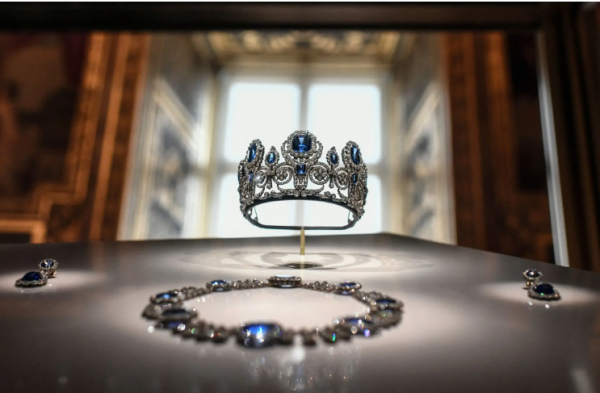
By now, most people are likely aware of the historic robbery of the Louvre’s Apollo Gallery on October 19th, 2025. On this day, a group of four men armed with power tools took to a monte-meuble, or stair car, to access the gilded room that houses much of France’s historic jewelry. The perpetrators were able to escape on two high-powered scooters with eight items, all of which were 19th-century artifacts worn by French royalty. The thieves did drop one crown during their escape, Empress Eugenie’s crown, damaging the artifact. Among the pieces stolen were Empress Eugenie’s diamond bow, thought to be a belt buckle, Queens Marie-Amelie and Hortense’s sapphire jewelry set, and Marie-Louise’s emerald necklace and earrings, which were a gift from her husband Napoleon in honor of their wedding.
The thieves arrived at the window of the Apollo Gallery at about 9:30 local time, and used glass cutters to break the window and enter the room. They promptly threatened security, forcing them to leave the premises, and set about using their tools to break open the glass cases containing the relics. They spent no more than four minutes inside the museum, and authorities were unable to catch them during their departure by scooter. According to Natalie Goulet, a member of the French Senate, “The gallery’s localized alarm was recently broken, and ‘we have to wait for the investigation to know if the alarm was disactivated'”(BBC). Nearly 60 investigators are currently working to find the four perpetrators, the main focus is recovering the jewels, which are expected to be dismantled and sold as individual gems to avoid suspicion.
As one would expect, the French people are saddened and distraught over this act against their nation’s history. They take the acts as a crime against their past, as the jewels are not only expensive, but hold immeasurable value to the people due to their fame and place in the country’s antecedents.
Needless to say, this brazen crime has become a notable event around the world and has greatly impacted French citizens, but should officials be looking into a deeper pattern of robberies? It seems that history would say yes. Just in the past year, a concerning pattern of thefts at French museums has emerged, showing an uptick in robberies, and only some of the stolen items have been recovered. For instance, the Adrien Duboche Museum was robbed of about $11 million worth of porcelain figures last month, and the Cognacq-Jay Museum had 7 items stolen in November of last year, 5 of which were recovered recently. This alarming trend goes back even further, with the 1998 robbery of Le Chemin de Sevres, a famous 19th-century painting which was never recovered. The most memorable robbery, many would say, was the 1911 theft of the Mona Lisa by an Italian employee of the Louvre who walked out with the painting under his jacket, desiring to return it to its home country of Italy. The then-obscure artwork was recovered two years later.
Though there has been a recent overhaul regarding security, with the Louvre petitioning the French government to fund security upgrades and new technology, should this technology have come soon enough to save the eight precious artworks lost this October? By now, chances are that the jewelry has been dismantled and is in the process of being sold piece by piece to the highest bidder, and the iconic pieces of art that were once beloved by the French people are now lost to the ages. Not to mention, the thieves approached the museum on stairs, simply walking up to the window and breaking their way into the gallery before escaping on scooters. The seemingly simple nature of this robbery only throws salt in the wound of the Louvre, as it seems like something that could only happen in a movie. In the midst of this distress, the country must ask, what could’ve been done to prevent this heist?
Bibliography: